Every agency owner you know is obsessed with new business. New leads, new quotes, new policies bound. That obsession made sense in the 1990s when carrier appetite was hungry, lead costs were low, and the book of business you inherited practically renewed itself. It makes much less sense today.
The most profitable growth lever in your agency right now is the book you already have. It sits on your AMS, quietly bleeding value, while you spend your mornings refreshing EverQuote and your afternoons chasing warm leads at $38 a pop. This lesson is about why that is happening, what it costs you, and why this is the year to finally do something about it.
The math most agents skip
The average independent agency loses somewhere between 10 and 18 percent of its book every year to lapse. Not to non-payment. Not to price shopping alone. Most of it walks out the door because the agent never reached out at the right moment, or reached out with a generic message that felt templated, or waited until the policy was already gone to try to save it.
Here is the part that stings. The commission on a renewal is, in most cases, identical to the commission on a new policy in year one. But the effort and cost to produce a renewal is a tiny fraction. A new-business policy costs you lead spend, quoting time, carrier placement effort, onboarding, and the emotional labor of turning a cold prospect into a warm client. A renewal costs you a thoughtful check-in and maybe a remarket.
Run the numbers on a typical 800-policy agency:
- Lapse cost at 15 percent: 120 policies × $144 average commission = $17,280 lost per year
- Cost to replace those policies: 120 new leads × $38 average lead cost = $4,560 just to get them in the door, plus 60 to 80 hours of producer time to quote and bind
So you are spending five thousand dollars and two work-weeks to recover revenue you already had. Every year. That is not growth. That is a treadmill.
Every one percent of retention you claw back is the equivalent of bringing in a lead pipeline that has zero acquisition cost, zero quoting time, and zero competitive friction. It is the most undervalued growth lever in the entire independent agent channel, and most agents are leaving it untouched.
The compounding problem
That $17,280 number is the floor, not the ceiling. A policy that lapses this year wasn't just worth $144. It was worth $144 this year, plus $144 next year, plus $144 the year after. It was also worth every cross-sell opportunity that relationship would have produced, every referral that client would have sent, and every auto-to-home or home-to-umbrella conversion that would have happened organically over the next five years.
Real lifetime value on a lost policy is usually two to four times the first-year commission. A 4x multiplier on our example agency turns a $17,000 annual bleed into $68,000 of compounded lost value. That is a producer's salary. Every year. Forever.
The three kinds of lapse
Not every lapse is the same, and the solution depends on the category. As a working model — the exact split varies by book, and you'll measure your own in lesson 2 — lapses break down roughly like this:
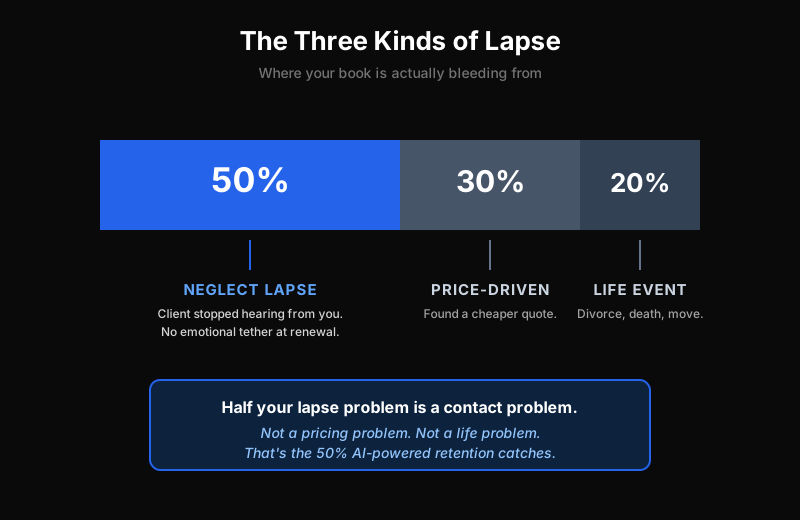 Three kinds of lapse: 50% neglect, 30% price-driven, 20% life event
- Price-driven lapse (about 30 percent). The client found a cheaper quote. Sometimes this is real competitive pressure. More often it is the client feeling uncertain about value and using price as a proxy for an unspoken concern.
- Life-event lapse (about 20 percent). Divorce, death, move out of state, business sold, car totaled and not replaced. These are mostly unrecoverable, but many of them could have been caught earlier and converted into a different product.
- Neglect lapse (about 50 percent). The client stopped hearing from you. They did not feel seen. When the renewal bill arrived, there was nothing emotionally tethering them to staying. These are the lapses that AI-powered retention catches.
Write that down. Half of your lapse problem is not a pricing problem or a life problem. It is a contact problem. The solution is not a hard sell. The solution is a system that makes every client feel seen without forcing you to work 70 hours a week.
Why now
The reason retention is suddenly a live conversation is simple. Until recently, running a proactive retention system required either a full-time CSR dedicated to outreach or a custom-built AMS integration that cost more than it returned. A 500-policy shop could not justify either. So nobody did it, and the industry collectively shrugged at a 15 percent annual bleed.
AI changes that equation. With a weekend of setup and a handful of tools you already pay for, a solo agent can now run the kind of personalized, trigger-based outreach that used to require a team. Draft a thousand personalized emails in ten minutes. Spot the 40 at-risk clients in your book of 800 without a data analyst. Summarize six months of a client's email history before a renewal call. These are all things that were impossible at your scale twelve months ago and are trivial today.
That is what this course is going to show you how to build.
What this course will not do
A quick level-set on expectations, because this matters.
This course will not replace your license, your judgment, or your relationships. It will not automate your agency out of existence. It will not write coverage recommendations, touch E&O exposure, or make decisions that belong to a human professional. If that is what you are looking for, you are in the wrong place and you are also several years too early on the technology.
What this course will do is give you a working AI-powered retention system built to take renewal outreach off your plate hour-for-hour and to recover a meaningful share of the policies you are currently losing to neglect — your recovery rate depends on your book, and lesson 2 has you baseline it so you can measure the lift for yourself rather than take a number on faith. It is also enough to pay for a producer, fund a marketing budget, or just buy back your weekends.
What you'll take away from this lesson
Start with one number. Pull your policy count from your AMS. Multiply by your average annual commission. Now multiply that by your lapse rate. If you don't know your lapse rate, use 15 percent as a placeholder for now — we will tighten it in the next lesson.
That number, in dollars, is how much your agency is quietly bleeding every year.
Write that number down somewhere you will not lose it. A note in your phone is fine. You are going to revisit it in Module 4 when we measure the ROI of the system you built. The whole course is, in a sense, a bet against that number.
Do this today
Open a blank spreadsheet. Four cells, nothing fancy:
| Cell | Label | Value |
|---|---|---|
| A1 | Total policy count | (from your AMS) |
| A2 | Average annual commission per policy | (total commission ÷ policy count) |
| A3 | Estimated annual lapse rate | 0.15 (use this if unknown) |
| A4 | Annual lapse cost | =A1*A2*A3 |
That is your baseline. Screenshot it. You are going to stare at that number when you get tempted to skip a module.
Next up
In the next lesson we tighten up that number, segment your book by where the lapse cost is actually concentrated, and turn it into a budget for the system you are about to build.